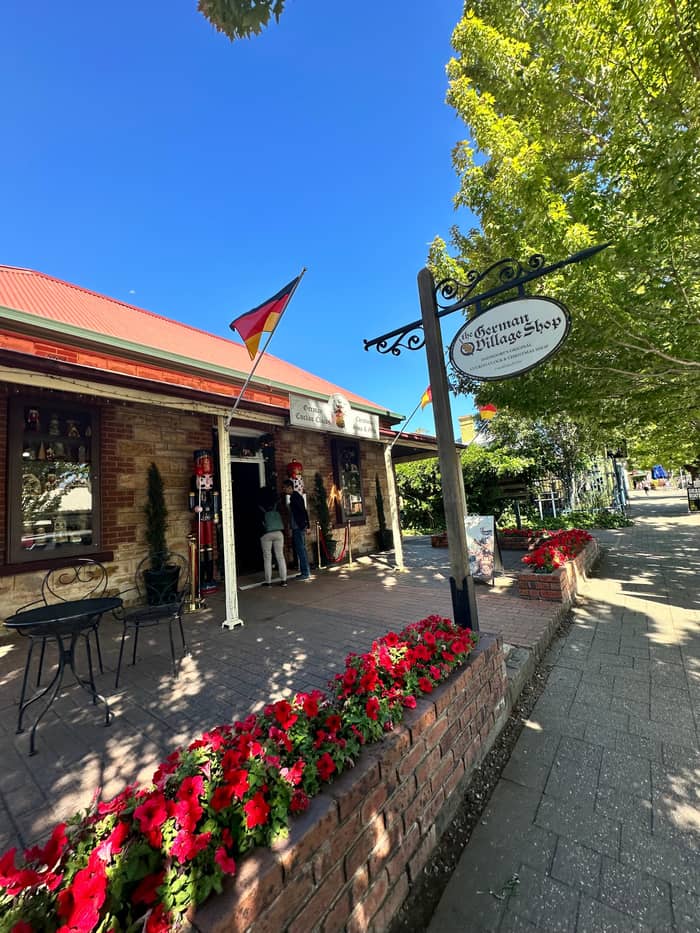
Guided
Hufendorf walk
The north end with a guide
- LengthAbout 90 minutes
- Route1 km
- InsideSt Michael's
Your stop on the map
Hahndorf Walking Tour, South Australia
★ 4.8 · 41 reviews total
See 18 route stops
Pick a route and tap a pin or a stop: you get its note and a Google Maps link.
Galleries, a museum and a shop, open daily 10:00 to 17:00.
Google MapsContinues the first licensed hotel in Hahndorf, founded in 1839.
Google MapsTrading since 1863, when it opened as the Union Hotel.
Google MapsBuilt in 1890, with a bell imported from Germany.
Google MapsPick-your-own strawberries from November to April.
Google MapsA winery at the edge of the village, known for Austrian grape varieties.
Google Maps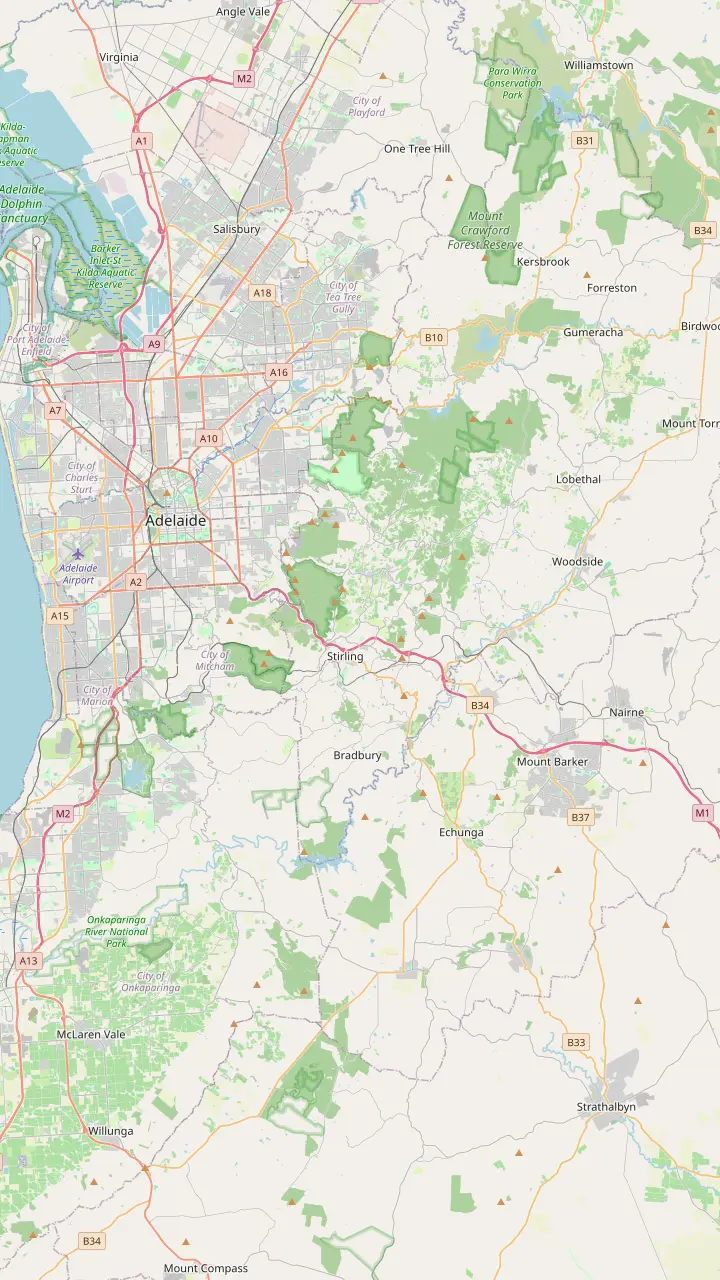
The site tour starts and ends here; the driver meets you inside by the bus bays.
Google MapsThe six-lane South Eastern Freeway climbs into the hills here on its way to Melbourne.
Google MapsThe freeway exit for Mount Lofty; the link trail to the summit starts opposite the bus stop.
Google MapsMarket Sunday is the fourth Sunday of the month, the third in December.
Google MapsThe giant waterwheel still turns at the old Bridgewater Mill.
Google MapsAustralia's oldest surviving German settlement, 28km south-east of Adelaide.
Google MapsIts community library is a visitor information outlet for the hills.
Google Maps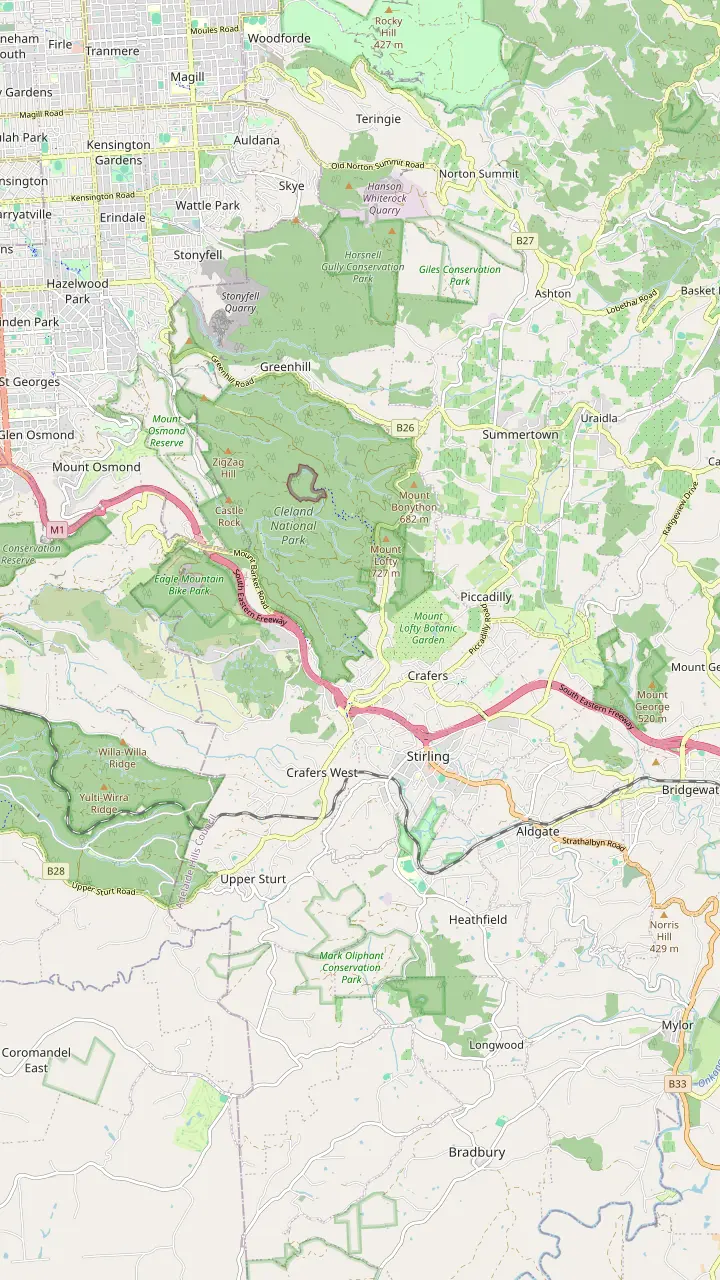
More than 710 metres above sea level; free entry, paid parking.
Google MapsOpen 9.30am to 5pm daily; one of few places in the world to hold a koala.
Google Maps97 hectares of cool-climate garden; parking machines take cards only.
Google MapsThe largest of the 7 waterfalls in Cleland National Park.
Google MapsA hills village on the site tour's route to Hahndorf.
Google MapsMapping data © OpenStreetMap contributors
This Hahndorf walking tour follows the official heritage trail down Main Street: who built the village, how its plan works, why it once lost its name and which houses still tell the story.
Editorial team, hahndorftour.com · Updated November 8, 2026 · Takes 8 min
Ask what is Hahndorf known for and the state heritage agency answers in one line: it is Australia's oldest surviving German settlement, established in 1839, 28km south-east of Adelaide.2 The state tourism body adds a detail that explains a lot about the town: Hahndorf was the first Australian settlement designed specifically for immigrants who were not British.8 The German bakeries and beer halls on Main Street today are a modern echo of that start.
Long before any of that, this was Peramangk country. The village's visitor site gives the old name of the district as Bukartilla, and the Hahndorf Academy's museum spells it Bukatila and translates it as deep pool.9,10 Peramangk country ran north from Mount Barker through Gumeracha and Springton towards Angaston, and south to Strathalbyn, and its people traded ochre, flint, quartz and possum skins with their Kaurna and Ngarrindjeri neighbours.11,12
The third thing the town is known for is a painter. Sir Hans Heysen and his wife settled in Hahndorf in 1908, and his drawings of its farms and people are a large part of how Australians picture the place.13 Walk the street with that in mind and you start to see the barns and gums from his pictures between the shopfronts.
The walk, stop by stop
| Where | Building | Built or opened | Look for |
|---|---|---|---|
| Main Street, south | St Paul's Lutheran Church | 1890 | Bell from Germany |
| 34 Main Street | Rodert's cottage | 1847 | Date on the lintel |
| 35 Main Street | Hahndorf Inn | 1863 | Former Union Hotel |
| 73 Main Street | Haebich smithy | 1880 | Drawn by Heysen |
| 98 Main Street | Wittwer's mill | Restaurant from 1971 | Old mill building |
| Church Street corner | St Michael's | 1859 | Oldest congregation |
Dates from the State Heritage Branch's Hahndorf heritage trail; every building is occupied, so view from the street.25,26,27,28,29,30,31
The story starts in Prussia, when Lutheran families who refused to join the new state church sought somewhere to worship freely. Pastor August Kavel looked for a safe destination, and George Fife Angas, a founder of the South Australian colony, helped fund their migration.19 Adelaide Hills Tourism places Hahndorf with Lobethal and Birdwood among the Hills towns founded by Prussians fleeing religious persecution.20
The ship Zebra reached Holdfast Bay on 28 December 1838 with 188 German Lutheran immigrants from 38 families.21 The passengers came ashore on 2 January 1839 and went looking for land they could farm.14 The heritage agency puts it simply: 38 Lutheran families settled the area after arriving aboard the Zebra, captained by Dirk Hahn, and they named the town after him.1 Picture the families walking up from the plains into the gum forest with everything they owned.
The village's own history page explains the choice of name. The settlers held Captain Dirk Meinertz Hahn in high regard for the care he had shown on the voyage, so they called their village Hahndorf, Hahn's village.3 It is a rare thing in Australia, a town named by its first families for the man who brought them, and a good story to tell children as you stand at the top of Main Street.
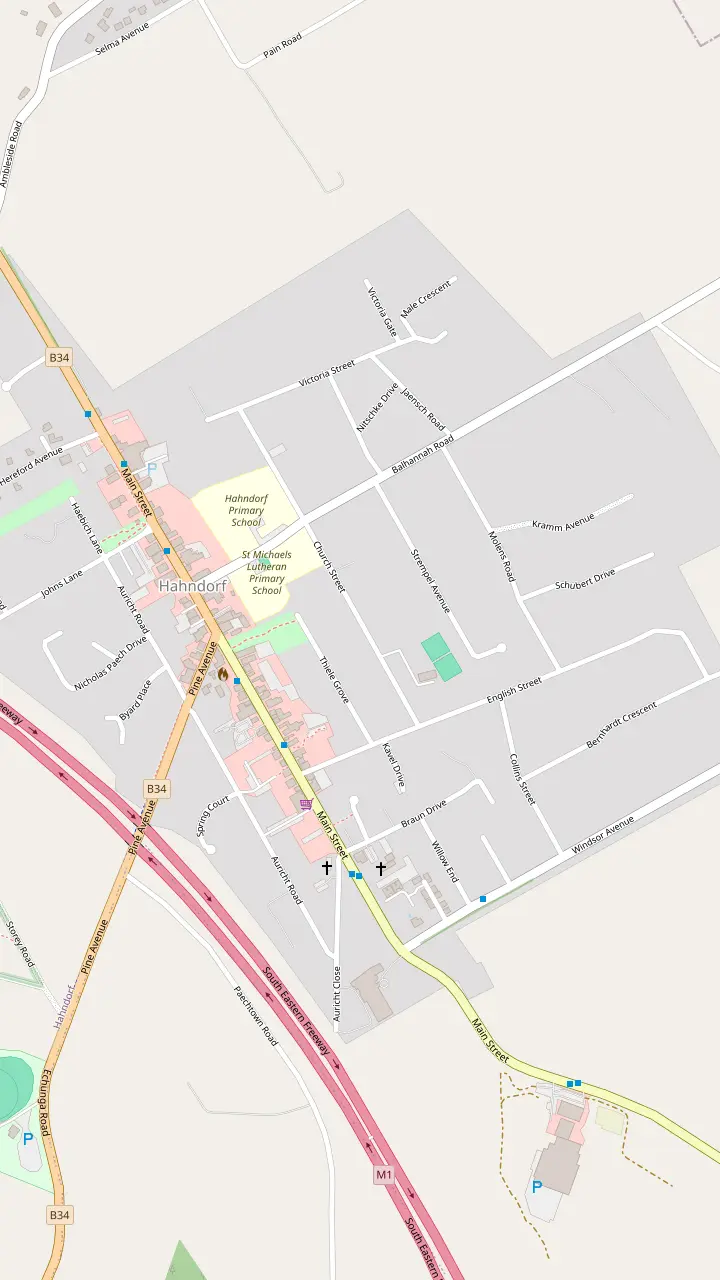
Hahndorf's layout is the key to the walk. The heritage agency describes it as unique: it combines the farmlet plan called Hufendorf with the street village plan called Strassendorf, both from historical Prussian planning.4 In 1839 the first village was a U-shaped Hufendorf of small farmsteads, focused on the Lutheran church where St Michael's stands today.37 It lay north-east of Main Street, on English, Church and Victoria Streets.38
In 1849 the settlement grew across to the south-eastern side of Main Street, which took the look of a Strassendorf, a village strung along a road.15 You can still see that plan in the line of the allotments, which were subdivided in 1850.15 The village's history page describes the original core as an Angerdorf, a village built around a broad green, and that green is today's Main Street.39 The State Heritage Area is centred on Main and Victoria Streets.40
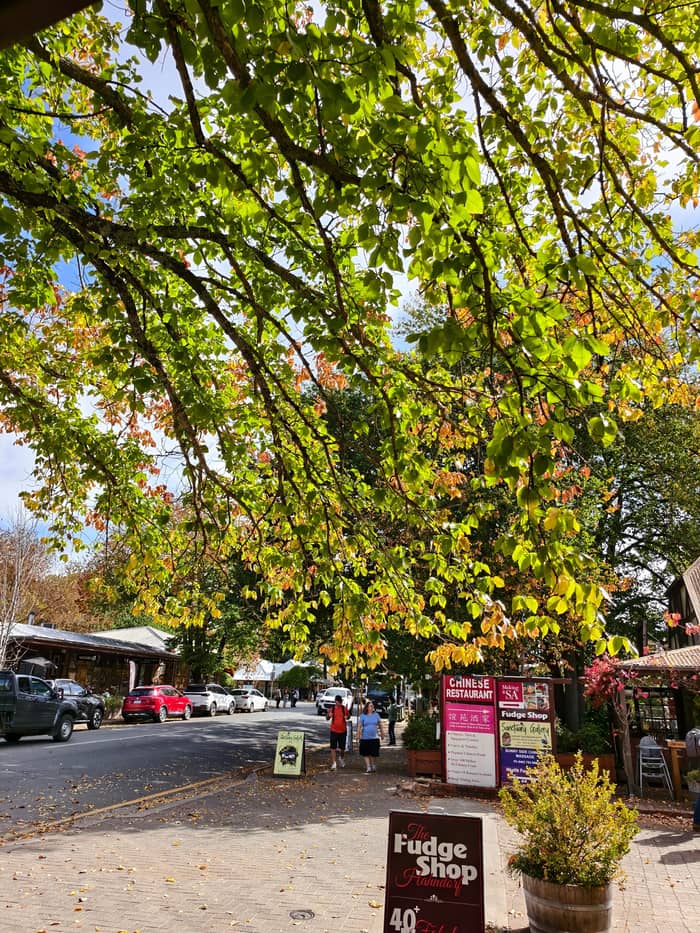
Look up at the roofs and walls as you go. Many early cottages use Fachwerk, the German half-timbered method: a timber frame with panels of pug, brick or stone set between the posts.41 The trees overhead have their own date: the Main Street elms, chestnuts and plane trees were planted on 19 August 1885 and still shade the street.17 The whole town was declared a State Heritage Area by the state government in 1988.7
Choose your walk
Match the walk to your time, your company and your taste for stories.
If I want the inside of the churches
A guided walk
The guided walks step inside St Michael's or St Paul's.32,33
If I want it free and at my own pace
The heritage trail
Every stop is on Main Street, from St Paul's to St Michael's.25,30
If I want an evening out
The After Dark walk
Dinner at 6:00 pm, then a 7:30 pm walk with a torch.34
If I care most about the art
Academy, then The Cedars
Heysen's drawings at the Academy, his studio at The Cedars.13,35
If I am with young children
A short self-guided loop
The After Dark walk welcomes families too.36
Ways to walk it
Guided
The north end with a guide
Evening
Dinner, then a torchlit walk
Self-guided
The heritage trail
A Hahndorf self-guided walking tour needs no ticket, only the heritage trail in your hand and an hour or two. Start at the south end near St Paul's Lutheran Church, built in 1890 to mark the 50th anniversary of the first Lutheran church in Australia, with a bell brought from Germany.25 Early brides arrived at the Lutheran church by German wagon, dressed in black with wreaths of green and white leaves.61
Walk north. At 34 Main Street the undertaker Carl Rodert's low cottage carries 1847 on its door lintel.26 Across the road, the Hahndorf Inn at 35 began trading in 1863 as the Union Hotel.27 Further on is the Hahndorf Academy, opened as a school in 1857 by Traugott Wilhelm Boehm; more than 700 students passed through it.16,22 Opposite, the German Arms continues the first licensed hotel of 1839 in a building of the early 1860s.48
Keep going. Sonnemann's old bakery at 72 Main Street baked for about 100 years, and the Haebich smithy at 73, built in 1880, appears in Heysen's drawings.62,28 Wittwer's mill at 98 stopped milling in 1912 and became a restaurant in 1971.29 At 102, family tradition says the first couple to marry in the village wed under a red gum that later went into their house of 1845.63 Finish at St Michael's, opened in 1859; its congregation, founded in 1839, is the oldest Lutheran one still gathering anywhere in Australia.30
Key dates
Settlement
The Zebra's passengers disembark and settle the village.14,1
Expansion
The settlement grows across Main Street in 1849.15
The Academy
Boehm opens the Hahndorf Academy in 1857.16
The trees
Elms, chestnuts and planes go in on 19 August 1885.17
War
The name changes in 1917 and the Lutheran school closes.5
Restored
The name returns in 1935, ahead of the centenary.6
Bypass
Through traffic leaves Main Street in 1974.18
Protection
The state declares a State Heritage Area in 1988.7
The First World War hit the village hard. In 1917 the village became Ambleside, named for a railway station nearby, and the Lutheran Day School was shut.5 The German Arms had already become the Hahndorf Hotel in 1916 and then turned into Hotel Ambleside; it only took back its first name in 1976.64 Stand outside it and you are looking at a building that changed the name over its door more than once in the war years.
The Academy went through the same years in another role. From 1917 to 1937 it was a hospital and nursing home where staff looked after 999 patients and 580 babies came into the world.23 Between 1938 and 1959 it held council offices, a wartime military headquarters, a betting shop and a dentist with a habit of dropping extracted teeth through a hole in the floor.65
The name came back in 1935, as South Australia's gesture to its German pioneers ahead of the centenary the following year.6 The village's later shape as a visitor town is just as datable. Through traffic left Main Street for the South Eastern Freeway in 1974, which handed the street back to walkers.18 Read together, these dates explain why Hahndorf feels both old and carefully kept: it was nearly erased, then deliberately restored.
Video
Tony Robinson Rewrites History on YouTube · The video only starts loading on your tap.
Hahndorf's layout is unique, combining characteristics of both the farmlet (Hufendorf) and street village (Strassendorf) patterns of historical Prussian planning
Before you walk
Heysen, who lived from 1877 to 1968, settled in Hahndorf with his wife in 1908, and his drawings of the village made between 1906 and 1920 are on permanent display at the Academy, a short walk from where many of them were drawn.13 From 1912 the family lived at The Cedars, a property outside town where he worked until his death.66,67 His daughter Nora went on to win the Archibald Prize, the first woman ever to do so.66
The Academy's link to him is direct. After years of decay, the restored building reopened as a gallery and folk museum on 8 October 1967, on Heysen's 90th birthday, with an exhibition of his work and some 2000 visitors in attendance.24 In 1960 the council had declared it unsafe and put it up for auction.68 The smithy at 73 Main Street is one of the buildings he drew, so you can stand where he stood and compare the scene with the sketch.28
To go further, drive out to The Cedars. Its studio, built in 1912, is thought to be the oldest surviving studio in the country built for an artist, and house tours run at 11am and 2pm from Tuesday to Sunday.35,69 Our things to do page has the entry fees and the opening days, so check it before you drive out. Together, the Academy drawings and the studio at The Cedars turn a walk through an old village into a walk through one artist's view of it.
If you prefer a guide, Hahndorf Walking Tours has run escorted walks since 2011.70 The Hufendorf walk takes about 90 minutes on a 1 km route and goes into St Michael's Lutheran Church; the Strassendorf walk, also 90 minutes, covers the southern end and steps inside St Paul's.32,33 Each costs AUD 49, and bookings need a minimum of 2 people or payment for 2.60,58 Book ahead in busy months.
The After Dark walk starts with dinner at The Haus at 6:00 pm, and the guide meets you at 7:30 pm; bring your own torch.34 It is not a ghost tour, and families are welcome.36 It is listed at AUD 99 with the meal.60 A morning Kaffee and Kuchen walk begins with cake at The Haus from 10.00am and sets off at 11.00am outside the Hahndorf Inn.71 The operator says all its sites are wheelchair accessible.59 The walk you can book on this page runs for 1.5 hours, is led live in English and gathers outside the Hahndorf Inn; it costs from $45, and you can drop it without charge up to 24 hours before.
Whichever way you walk, remember that these are homes and businesses. The heritage trail reminds visitors that every building in the village is occupied and that the occupants' privacy should be respected.31 Take photos from the footpath, keep out of private gardens and backyards, and step into the shops that now fill many of the old cottages. That is the best way to see inside them.
FAQ
The settlers named it after the captain of the Zebra, which brought them in 1838.1
The operator says it is not a ghost tour and families are welcome.36
Founded in 1839, the St Michael's congregation is the oldest Lutheran one still gathering in Australia.30
The Government of South Australia declared it a State Heritage Area in 1988.7
Sources
Further reading
Planning a day in the Adelaide Hills? Ask a real person here.